
Key Takeaways
- A medical marijuana card, license, certification, or registry credential allows eligible patients to access medical cannabis under their state’s program.
- Eligibility rules are not the same everywhere. Some states use specific qualifying-condition lists, while others give physicians broader discretion.
- Telehealth may be available for medical cannabis evaluations in states that permit remote certification.
- Physician fees, state fees, registration requirements, and renewal periods differ from one program to another.
- In April 2026, federal authorities placed certain marijuana products covered by qualifying state-issued medical marijuana licenses in Schedule III. Broader federal rescheduling remained a separate proceeding.
What Is a Medical Marijuana Card and Why Does It Matter?
“Medical marijuana card” is a common umbrella term. Depending on the state, it may refer to a physical card, digital credential, patient license, registry identification card, or written certification used to show that a patient is eligible under a medical cannabis program.
The process is not the same everywhere.
Some states require patients to register with a state agency after receiving a physician’s certification. Others use a simpler model that allows patients to use their certification and identification directly at a licensed dispensary.
Virginia is a good example. Patients do not need to complete separate state registration simply to access medical cannabis. A valid written certification from a qualified practitioner and a current government-issued ID are the main documents used at licensed dispensaries. A written certification can remain valid for up to one year unless the practitioner sets an earlier expiration date.
Federal rules also changed in 2026.
On April 23, 2026, the U.S. Department of Justice and Drug Enforcement Administration announced an order immediately placing FDA-approved products containing marijuana and marijuana products subject to a qualifying state-issued medical marijuana license in Schedule III under the Controlled Substances Act.
That did not mean all marijuana in the United States automatically moved to Schedule III. Broader federal rescheduling continued as a separate process.
Qualifying Conditions for a Medical Marijuana Card by State
Eligibility for medical cannabis is based on state law and the judgment of an authorized practitioner.
Some states use a defined list of qualifying medical conditions.
Pennsylvania, for instance, recognizes serious medical conditions including cancer, epilepsy, Crohn’s disease, PTSD, autism, sickle cell anemia, anxiety disorders, multiple sclerosis, Parkinson’s disease, and severe chronic or intractable pain.
Other programs work differently.
Oklahoma does not use the same kind of fixed qualifying-condition list found in some states. Applicants submit a physician recommendation as part of the licensing process, and eligibility depends on that recommendation along with the state’s application requirements.
There was also an important change in 2026. Beginning January 1, physicians providing medical marijuana recommendations in Oklahoma must complete required medical marijuana education and register with the Oklahoma Medical Marijuana Authority before providing recommendations to patients or applicants.
Patients researching eligibility can review the state’s requirements and Oklahoma medical marijuana qualifying conditions before starting the application process.
It is worth checking the current rules before applying. Qualifying-condition guidance, physician requirements, and application procedures can change.
Texas shows how quickly a state program can evolve.
House Bill 46, which took effect September 1, 2025, expanded the Texas Compassionate-Use Program, added qualifying conditions, increased access through additional licensed dispensing organizations and satellite locations, and expanded the availability of dosage forms.
Patients considering the program should first review the current Texas medical marijuana qualifying conditions to see whether their condition may meet the state’s requirements.
Texas also uses a different registration model. Patients do not separately register themselves in the Compassionate Use Registry of Texas. A qualified physician enters the prescription into CURT, and licensed dispensing organizations use the registry when dispensing under the prescription.
The practical takeaway is simple: old condition lists are not always reliable. Current state guidance matters.
How to Get a Medical Marijuana Card Through Telehealth
Telehealth can make the certification process more convenient in states that allow remote medical cannabis evaluations.
The basic process usually looks like this:
1. Confirm Your State’s Eligibility Rules
Start with the rules where you live. Check whether your condition and circumstances fit the current program requirements.
2. Find an Authorized Practitioner
The healthcare professional must meet the licensing, registration, and certification requirements set by the state.
3. Complete the Medical Evaluation
The practitioner reviews relevant medical history, current symptoms, previous treatments, medications, and other information that may affect the evaluation.
4. Receive a Certification or Recommendation
When the practitioner determines that the patient qualifies, they complete the appropriate certification, recommendation, or state documentation.
5. Complete Any Required State Registration
Some states require a separate patient application, license, ID card, or registry step after the medical evaluation.
Others do not. Virginia, for example, does not require a separate patient registration simply to access medical cannabis.
6. Access a Licensed Dispensary
After the state’s requirements are complete, eligible patients can access medical cannabis under the rules of that program.
Telehealth rules are not uniform across the country. A remote evaluation that is allowed in one state may not follow the same process in another.
What to Expect During an Online Evaluation
A medical cannabis evaluation is a medical consultation, not simply an approval form.
The practitioner may ask about current symptoms, medical history, existing diagnoses, medications, previous treatments, and other information relevant to the evaluation.
Patients may also be asked to provide supporting medical records or explain why they are considering medical cannabis.
From there, the practitioner decides whether the patient meets the applicable requirements and whether issuing a certification or recommendation is appropriate.
The exact process depends on the jurisdiction.
In Oklahoma, for example, adult patient applicants must submit a physician recommendation as part of the licensing process. As of 2026, that recommendation must come from a physician who meets OMMA’s registration and medical marijuana education requirements.
Documents and Preparation Checklist
A little preparation can make the evaluation process easier.
Commonly requested documents may include:
- Government-issued identification
- Proof of residency where required
- Relevant medical records
- Information about current medications
- Previous treatment history
It may also help to have:
- Previous diagnoses
- Current symptoms
- Symptom frequency and severity
- Previous treatment results
- Questions about the medical cannabis program, product formats, or state access requirements
Not every program asks for the same documentation. Follow the instructions provided by the evaluating practitioner and your state’s medical cannabis program.
Medical Marijuana Card Costs: Doctor Visits, State Fees, and Renewals
There is no single nationwide price for getting a medical marijuana card or certification.
The total cost can include several separate expenses:
- Physician or telehealth evaluation fees
- State application or registration fees
- Patient identification card or license fees
- Renewal fees
- Optional costs for medical records or other documentation
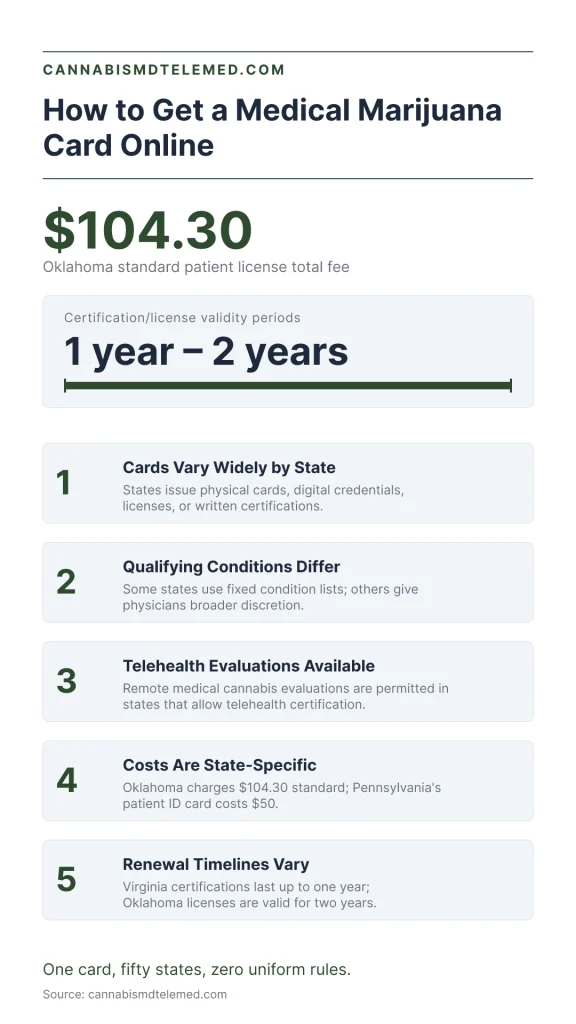
Oklahoma currently charges a $100 patient-license application fee plus a $4.30 credit card processing fee, for a standard total of $104.30.
Patients who provide qualifying proof of Medicaid or Medicare enrollment, or status as a 100% disabled veteran, pay a reduced $20 application fee plus a $2.50 processing fee, for a total of $22.50.
Standard Oklahoma adult patient licenses are valid for two years.
Pennsylvania uses a different fee structure. The medical marijuana patient ID card costs $50, while patients participating in Medicaid, PACE/PACENET, CHIP, SNAP, or WIC may qualify for a no-cost card.
Texas works differently again. Patients do not submit their own registration into CURT. A qualified physician enters the prescription into the state registry.
This is why broad national cost estimates can be misleading. The actual amount depends on the state, the provider, and whether separate licensing or registration fees apply.
Card Renewal and Certification Periods
Renewal timelines also depend on the program.
Some states require annual certification. Others issue licenses that remain valid for longer periods.
Virginia uses a certification-based system. A written medical cannabis certification can be valid for up to one year unless the practitioner sets an earlier expiration date.
Oklahoma adult patient licenses are generally valid for two years.
Patients should check the expiration date on their own certification, card, or license and review renewal requirements before it expires.
Tips for First-Time Medical Marijuana Patients
For someone new to a medical cannabis program, one of the first things to understand is what products are actually allowed and available in that state.
Depending on local rules and dispensary availability, regulated medical cannabis products may include:
- Flower
- Tinctures
- Edibles
- Capsules
- Topical products
- Other state-approved formulations
These products can differ in cannabinoid content, formulation, onset, duration, and potential for impairment.
Product labels are a useful starting point, but they do not answer every safety question. Patients can discuss product type, medication interactions, impairment, and other concerns with a qualified healthcare professional.
It is also worth remembering that product availability is not the same everywhere. Some states allow formats that others restrict.
Medical cannabis should not be assumed to affect every person the same way, and patients should not make changes to medications or treatment plans without discussing those changes with an appropriate healthcare professional.
Frequently Asked Questions
What exactly is a medical cannabis card and what does it prove?
A medical cannabis card, license, certification, or registry credential shows that a patient has met the requirements of a state’s medical cannabis program.
Not every state issues a physical card, so the exact form of documentation depends on the program.
What is the easiest way to get a medical marijuana card?
That depends on the state.
Where telehealth evaluations are permitted, an online appointment with an appropriately licensed or authorized practitioner may allow the medical evaluation to be completed remotely.
A separate application, registration, license, or ID-card step may still be required afterward.
Does getting a medical marijuana card involve a background check?
Medical cannabis programs generally focus on requirements such as identity, residency, practitioner certification, and program eligibility.
Because application rules are different from state to state, patients should check their own program rather than assume every jurisdiction uses the same process.
How does a medical marijuana card differ from recreational purchase?
Medical and adult-use cannabis programs operate under different state laws.
Depending on the state, medical programs may have different eligibility rules, purchasing limits, taxes, product requirements, age restrictions, or patient protections.
There is no single answer that applies nationwide.
At the federal level, the April 2026 DOJ and DEA action placed certain marijuana products subject to qualifying state-issued medical marijuana licenses in Schedule III. That action did not move all marijuana into Schedule III, and broader federal rescheduling remained a separate proceeding.
What qualifying conditions make me eligible?
There is no nationwide list.
Some states publish specific qualifying conditions. Others rely more heavily on an authorized practitioner’s judgment.
Pennsylvania, for example, maintains a defined list of serious medical conditions. Oklahoma instead requires a physician recommendation as part of its patient licensing process.
How long does a telehealth cannabis evaluation take?
There is no standard appointment length.
The time needed can depend on the practitioner, the patient’s medical history, and the state’s requirements.
A medical cannabis evaluation should leave enough time to review relevant information and answer questions rather than being treated as a simple formality.
How often do I need to renew my medical marijuana card?
Renewal periods are different from one program to another.
Virginia written certifications can be valid for up to one year unless the practitioner sets an earlier expiration date. Oklahoma adult patient licenses are generally valid for two years.
Is medical marijuana legal in Pennsylvania?
Yes. Pennsylvania operates a medical marijuana program for patients who meet the state’s eligibility requirements.
Patients must register with the program, receive certification from an approved practitioner, and obtain a medical marijuana ID card before purchasing medical marijuana from a Pennsylvania dispensary.
The patient ID card costs $50, although participants in certain government assistance programs may qualify for a no-cost card.
Can I use my medical marijuana card in another state?
Sometimes, but there is no nationwide reciprocity system.
Some states recognize certain out-of-state medical cannabis credentials or offer temporary access under specific rules. Others do not.
Before traveling, check the destination state’s current requirements rather than assuming your existing credential will be recognized.
What are the total costs including doctor visits and state fees?
There is no universal total.
Depending on the state, patients may need to pay a physician or telehealth evaluation fee, a state application fee, a registration fee, an ID-card fee, or renewal costs.
For example, Oklahoma’s standard patient-license application currently costs $100 plus a $4.30 card-processing fee, while Pennsylvania charges $50 for its medical marijuana ID card.
What should I bring to my medical marijuana evaluation?
A government-issued ID is a good starting point.
It can also help to have relevant medical records, information about current medications, and details about your medical history available.
The practitioner may request additional documentation depending on the state and the individual evaluation.
Understanding Your State’s Medical Cannabis Rules
Medical marijuana programs keep changing. States update qualifying conditions, physician requirements, fees, registration systems, purchasing rules, and available product forms. Federal policy also changed in 2026, when the Justice Department and DEA placed FDA-approved marijuana products and marijuana products subject to qualifying state-issued medical marijuana licenses in Schedule III while continuing a separate process concerning broader marijuana rescheduling.
For patients, the best place to start is with the rules that apply where they live. Before beginning the process, check the current qualifying conditions, practitioner requirements, application fees, certification or license periods, and registration steps for your state.
Eligibility is ultimately determined under the applicable state program and through an evaluation by an authorized healthcare professional.